
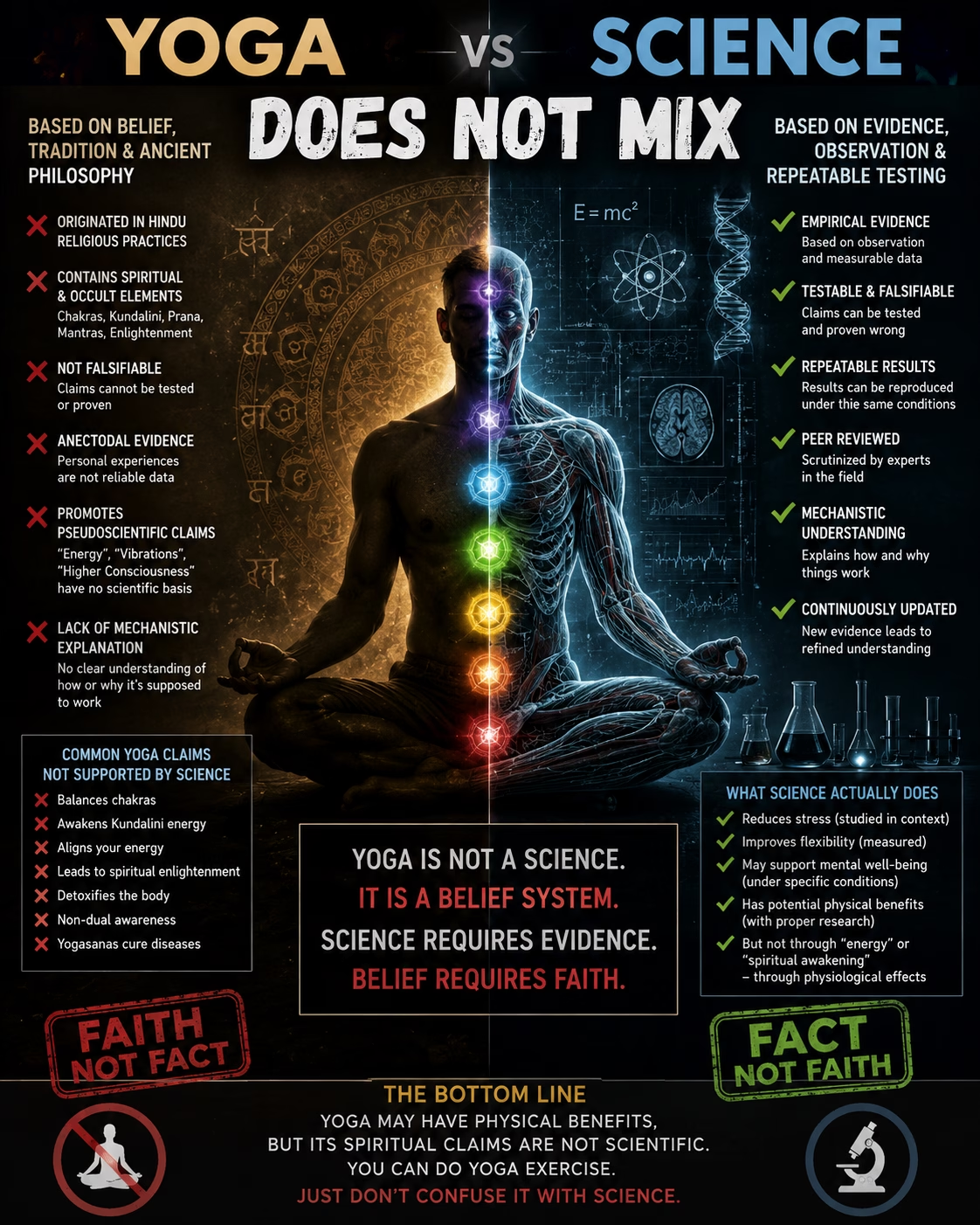
Search for yoga online and you will find two loud claims. bne says yoga is just science-backed stretching. The other says yoga is spiritual. A faithful Christian response asks better questions: what is being practised, what is being normalised, and what is the believer being yoked to?
Quick Answer
Yoga is not one simple thing. It can refer to physical postures, breathing drills, relaxation, meditation, philosophy, worship, commercial wellness or a complete spiritual system.
The wise path is to separate useful physical training from spiritual claims, avoid practices that ask for devotion to another worldview, and choose coaching that strengthens the body without confusing worship, conscience or faith.
This is not about fear. It is about spiritual discernment. Christians are called to honour God with the body, mind, heart and spirit, not to casually join practices that may carry spiritual meanings contrary to Christ.
KJV Scripture With Christian Discernment
These passages are kept in the King James Version because the issue is not only movement mechanics, but what a practice asks a Christian to join, receive, repeat or spiritually normalise.
The Christian concern is not that every stretch is sinful. The concern is whether a practice, class, chant, meditation or worldview spiritually yokes a believer to something other than the God of the Bible.
Be ye not unequally yoked together with unbelievers: for what fellowship hath righteousness with unrighteousness? and what communion hath light with darkness?
And what concord hath Christ with Belial? or what part hath he that believeth with an infidel?
And what agreement hath the temple of God with idols? for ye are the temple of the living God; as God hath said, I will dwell in them, and walk in them; and I will be their God, and they shall be my people.
Wherefore come out from among them, and be ye separate, saith the Lord, and touch not the unclean thing; and I will receive you.
2 Corinthians 6:14-17 KJV
What Does “Unequally Yoked” Mean?
The word “yoked” gives a farming picture. Two animals, such as oxen, were bound together with a wooden yoke to plough a field. If one animal was stronger, weaker, stubborn or moving in another direction, the work became strained, confused and disorderly.
Paul uses that picture to warn Christians against binding themselves spiritually, emotionally or relationally to what is moving in the opposite direction from God’s truth. Light and darkness are not meant to pull the same plough.
For relationships, this is often applied to marriage and deep spiritual partnership. For spiritual practices, it means Christians should not knowingly join themselves to practices rooted in false worship, occult spirituality, religious compromise or teachings that lead the heart away from Christ.
Applied to yoga, the question is not merely, “Did I stretch?” The deeper question is, “What am I being spiritually joined to, taught to repeat, invited to receive, or encouraged to normalise?”
There shall not be found among you any one that maketh his son or his daughter to pass through the fire, or that useth divination, or an observer of times, or an enchanter, or a witch,
Or a charmer, or a consulter with familiar spirits, or a wizard, or a necromancer.
For all that do these things are an abomination unto the LORD: and because of these abominations the LORD thy God doth drive them out from before thee.
Deuteronomy 18:10-12 KJV
Why This Matters for Spiritual Practices
Deuteronomy 18 warns God’s people not to seek guidance, power, spiritual experience or hidden knowledge through forbidden spiritual channels. The point is not superstition. The point is allegiance. God’s people are not called to mix worship of the Lord with practices that invite spiritual confusion, occult influence or another source of spiritual authority.
This matters when a wellness practice includes chanting, mantras, energy language, awakening divine power, kundalini, chakra systems, spirit guides, visualisation of spiritual forces or surrender to an unnamed universal consciousness.
A Christian may enter a class thinking, “I only intend to stretch.” But intention does not always cancel influence. Wisdom asks whether the practice itself is asking the believer to participate in something spiritually compromised.
Be sober, be vigilant; because your adversary the devil, as a roaring lion, walketh about, seeking whom he may devour.
1 Peter 5:8 KJV
Spiritual Awareness Is Not Fear
Peter does not call believers to panic. He calls them to be sober and vigilant. Christian discernment is not paranoia, harsh judgement or fear of movement. It is the clear-minded awareness that spiritual formation is real and that not every practice presented as harmless is spiritually neutral.
For the Christian, the body belongs to God. Training should build strength and discipline. It should not dull discernment or make spiritual compromise feel normal.
For God is not the author of confusion, but of peace, as in all churches of the saints.
1 Corinthians 14:33 KJV
God Is Not the Author of Confusion
When a practice blurs the line between exercise, worship, meditation, self-salvation and spiritual identity, Christians should pause. Confusion is not a small issue. God calls His people into truth, peace and holiness, not a mixed spiritual atmosphere where the language of wellness hides the roots of another worldview.
If stretching, mobility training, breath work, strength exercises, and walking offer the same physical benefits, Christians do not need to choose practices that make them uncomfortable.
Why Christians Ask Hard Questions About Yoga
Christians are not being awkward when they ask what yoga means. Words, rituals and repeated practices shape the heart. Scripture calls believers to love God with heart, soul and mind.
Modern yoga often blends movement, breathing, mindfulness, self-acceptance language, Hindu or Buddhist concepts, therapeutic claims and a commercial wellness identity. Some classes are almost entirely physical. Others include chanting, spiritual visualisation, mantras, chakra language or teachings about the self that clash with the Christian view of creation, sin, salvation and worship.
Movement
Stretching, balance work and controlled breathing can be ordinary physical training when taught plainly and safely.
Meaning
The same posture or breath cue may carry spiritual meaning in one setting and simple exercise meaning in another.
Worship
Christians should not join practices that direct trust, devotion or identity away from God.
Discernment point: No matter how softly modern wellness culture presents it, Christians should not ignore the spiritual roots, language and aims attached to a practice. Rebranding something as fitness does not automatically remove every spiritual meaning from it.
Not All Movement Is Just Movement
Some people say, “It is just stretching.” Sometimes that may be how a class is taught. But not all movement is spiritually empty. Prayer is more than words because the words have meaning and direction. In the same way, certain postures, chants or repeated rituals can carry spiritual significance, especially when they come from a religious system.
A Christian may have innocent intentions. However, intention does not always cancel influence. Scripture warns believers not to be unequally yoked and not to normalise practices that belong to another spiritual authority.
This is why Christians should not be pressured to ignore conscience. If a class includes mantras, spiritual surrender, energy work, deity language, chakra teaching or meditation that directs the heart away from Christ, it is not simply mobility training.
What Yoga Science Can and Cannot Prove
The science around yoga is mixed but useful when read carefully. Research can measure outcomes such as balance, flexibility, stress, back pain, blood pressure and sleep quality. It cannot tell a Christian whether a spiritual practice is faithful, whether a worldview is true or whether a class is spiritually wise.
That means the scientific question and the Christian question are related, but not identical. A study may show that a yoga programme helped people move better or feel calmer. That does not automatically validate every belief, ritual or spiritual claim attached to yoga.
Reviews of randomised trials suggest yoga can improve balance, flexibility and lower-body strength in older adults.
Systematic reviews report stress reduction in many yoga interventions, though class types vary widely.
Meta-analyses suggest yoga may reduce chronic low back pain and disability compared with non-exercise, but it is often similar to other exercise or physiotherapy approaches.
Yoga may have modest positive effects on blood pressure, BMI, lipid profile and HbA1c, but it should not replace medical care.
Christian critique point: If the physical benefits can also be gained through mobility training, strength work, breathing mechanics, walking, physiotherapy or sport-specific recovery, believers do not need to adopt a spiritual framework that troubles their conscience. Try Pilates
The Positive Alternative
Instead of Yoga, Try Pilates
Pilates is a much cleaner way forward for Christians who want the physical benefits people often look for in yoga. If the goal is flexibility, posture, core strength, controlled breathing, injury prevention and better movement, Pilates trains those qualities directly without the spiritual baggage that can come with yoga.
Unlike yoga, Pilates does not require chanting, mantras, chakras, kundalini, deity language, spiritual surrender or religious philosophy. It can be taught plainly as physical training: strengthen the core, improve alignment, build control, increase mobility and support recovery.
For believers, this matters. You can still breathe well, move well, recover well and build a stronger body without mixing exercise with spiritual practices that trouble the conscience.
Simple exchange: instead of yoga, choose Pilates. Keep the training physical, keep the conscience clear, and keep worship directed to God alone.
Red Flags for Christians Considering Yoga
- Chanting or mantras offered as spiritual practice.
- Language about awakening divine energy, chakras or kundalini.
- Guided meditation that asks you to surrender to an unnamed force, spirit or universal consciousness.
- Claims that yoga is a path to enlightenment, liberation or salvation.
- References to deities, spirit guides, cosmic energy or inner divinity.
- Pressure to ignore conscience because the practice is described as only exercise.
- A teacher or class environment that blends physical training with religious or mystical teaching.
Want Strength, Mobility and Recovery Without Confusion?
Train with a clear plan for your body, your sport and your values. All Round Athlete coaching can help you build mobility, strength, discipline and confidence without asking you to compromise your faith.
A Better Alternative: Mobility Training With Christian Clarity
If the goal is movement quality, pain-free training, posture, breathing or recovery, you can train those qualities directly. You do not need to rename everything yoga.
- Start with breathing mechanics: slow nasal breathing, rib expansion and relaxed exhaling.
- Train usable mobility: focus on hips, ankles, shoulders and spine through controlled ranges.
- Add strength: mobility lasts longer when the body can produce force in the new range.
- Progress like an athlete: track what improves, scale what hurts and keep sessions purposeful.
Simple rule: If you want stretching, do stretching. If you want breath control, train breathing. If you want prayer, pray. Keeping categories clear helps the body and conscience work together.
A Practical Discernment Framework
- What is being taught? Exercise instruction, spiritual teaching or a blend of both?
- What am I being asked to say or believe? Words matter, especially repeated words.
- What is being formed in me? Does this direct attention toward Christ, away from Christ or into confusion?
- What am I being yoked to? Does the practice connect me to Christ, or to a worldview that contradicts Him?
- Is there a cleaner way to get the same training benefit? Often, the answer is yes.
Why This Matters for Athletes
Athletes need bodies that can move, recover and perform. They also need minds trained in truth. A calm nervous system is useful. A flexible body is useful. But performance should not come at the cost of spiritual confusion.
For Christian athletes, the aim is not fragile avoidance. It is integrated strength. Train hard. Recover well. Breathe properly. Move with control keep worship where it belongs.
FAQ
Is yoga compatible with Christianity?
It depends what is meant by yoga. Christians should distinguish between physical movement, breath control, meditation, worship and spiritual teaching. Some may use mobility-style movements with a clear conscience. Others avoid yoga because of its religious associations. The key issue is whether the practice draws the heart toward Christ or toward another spiritual authority.
Is yoga just stretching?
Sometimes a class is taught almost entirely as stretching and mobility. Historically and in many modern settings, yoga can include spiritual philosophy, meditation, chanting and ritual. Calling it only stretching can hide important differences.
What does “unequally yoked” mean in relation to yoga?
To be yoked means to be joined or bound together. In 2 Corinthians 6:14, Paul warns Christians not to be unequally yoked with what opposes God’s truth. Applied to yoga, the question is whether the practice is only physical movement, or whether it joins the believer to spiritual language, rituals or teachings that conflict with Christ.
What does yoga science actually show?
Research suggests yoga can help some people with flexibility, balance, stress, chronic low back pain and certain cardiovascular markers. Science can measure physical outcomes, but it cannot settle Christian questions about worship and spiritual formation.
Can Christians do stretching without yoga?
Yes. Mobility, stretching, strength, breath mechanics and relaxation can all be trained without adopting yoga language or spirituality. A clear athletic programme may be a better fit for many Christians.
What should I do if I feel uneasy in a class?
Listen to your conscience. You can leave, ask the instructor what will be included, choose a different class or train with a coach who uses clear exercise methods. Peace with God matters more than fitting into a wellness trend.
Build a Body That Serves Your Calling
If you want coaching that develops strength, mobility, endurance, and confidence with clear values, let's train.
References
- Sivaramakrishnan et al. 2019. The International Journal of Behavioral Nutrition and Physical Activity.
- Wang and Szabo. 2020. Alternative Therapies in Health and Medicine.
- Zhu et al. 2020. PLoS ONE.
- Isath et al. 2023. Current Problems in Cardiology.
- Ko, Kwok and Chan. 2023. International Journal of Older People Nursing.
This article is for educational purposes and does not replace medical advice, physiotherapy, pastoral counsel or personal spiritual discernment.